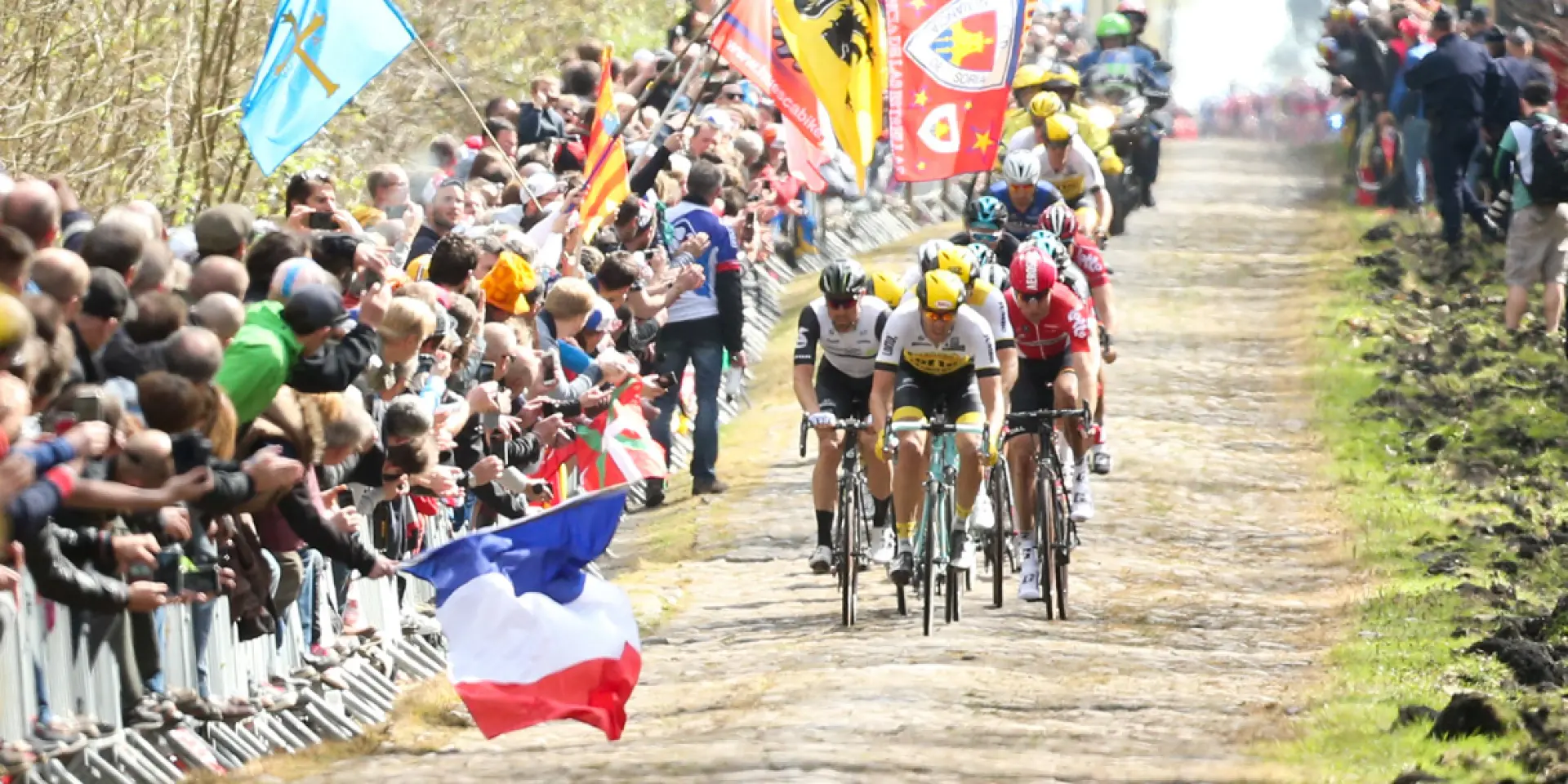
A race forged in myth and memory
Nicknamed The Hell of the North, The Queen of the Classics or even The Toughest of the Tough, Paris–Roubaix has earned its reputation over more than a century. Created in 1896, it stands alongside cycling’s most prestigious monuments, celebrated as much for its unforgiving terrain as for the champions who have conquered it.
Legends such as Eddy Merckx, Johan Museeuw, Bernard Hinault and Gilbert Duclos-Lassalle have all left their mark here, but the soul of the race also lies in its atmosphere. Every second Sunday in April, the roads fill with anticipation as crowds gather to cheer riders on, sharing picnics, stories and a deep respect for the challenge unfolding before them.
A route that tests every limit
Despite its name, Paris–Roubaix no longer starts in the capital. Since 1977, the peloton sets off from Compiègne, heading north on a demanding journey of nearly 250 kilometres. Along the way, riders face more than two dozen cobbled sectors — rough, uneven stretches that total almost 50 kilometres of relentless vibration and strategy.
Among them, the Trouée d’Arenberg remains the most feared. This narrow, forest-lined passage often reshapes the race in seconds, shaking up the peloton and testing nerves as much as strength. Later on, Carrefour de l’Arbre is frequently the decisive moment, where the strongest riders begin to emerge. From there, all eyes turn towards the final laps inside the Roubaix Velodrome, where victory, and the symbolic cobblestone trophy, awaits.
A heritage carved in stone
The cobbles of Paris–Roubaix are more than obstacles; they are part of the region’s identity. Once threatened by modernisation, many sections were close to disappearing altogether. Today, they are carefully preserved thanks to the dedication of local volunteers, including the Amis du Paris–Roubaix and regional horticultural schools, who restore the stones year after year.
Their work ensures that the race remains faithful to its roots, challenging, authentic and deeply connected to the landscape of Hauts-de-France.